There is a particular kind of phone call that can change the temperature of your whole day.
Someone needs money. A child is unwell. A relative is fighting with her husband. A colleague has missed a deadline. The family group chat is suddenly full of urgent messages, and somehow your name appears beside the solution.
You may not even be the person with the most time, money, experience, or emotional capacity. You are simply the person who usually responds.
And BOOM. Another crisis has quietly become your assignment.
Let’s face it, being dependable can feel deeply meaningful. It can also become a system where everyone else gets relief because you absorb the pressure. That is not the same thing as support.
When dependable becomes permanently available
The old way says the strong woman steps in quickly, figures everything out, and does not make people feel guilty for needing her.
The newer, healthier way asks a more honest question: what kind of help can I offer without making my own life unliveable?
A crisis is a serious or urgent problem. It is not every uncomfortable feeling, delayed reply, poor plan, or consequence that another adult would rather not face. If every request arrives with panic, you can lose the ability to tell urgency from intensity.
This is where the 20 questions game begins. Who is responsible? What is actually needed? What happens if I do not take over? What part belongs to me?
**Learning: Being caring does not make you the default manager of other people’s lives.**
The hidden cost of being the first call
When you carry every crisis, the cost is not only the time spent solving it. You also carry the anticipation, the follow-up, the remembering, and the emotional weather around it.
You are monitoring who is upset, who has not replied, who might need help next, and whether your solution worked. Your body may be resting while your attention remains on duty.
The Office on Women’s Health notes that caregiver stress can affect women’s health and wellbeing. Cleveland Clinic also describes caregiver burnout as involving symptoms such as exhaustion, stress, withdrawal, anxiety, or low mood. These are not diagnoses for you to assign to yourself. They are reasons to take ongoing strain seriously rather than calling it normal.
Support networks matter too. You can also read The Quiet Exhaustion of Being the Person Everyone Depends On. The American Psychological Association recommends strengthening social support as one way to manage stress. Notice the wording: a support network. Not one heroic woman acting as the single source of truth for everyone around her.
First, stop answering the alarm
You do not have to respond at the speed of someone else’s panic.
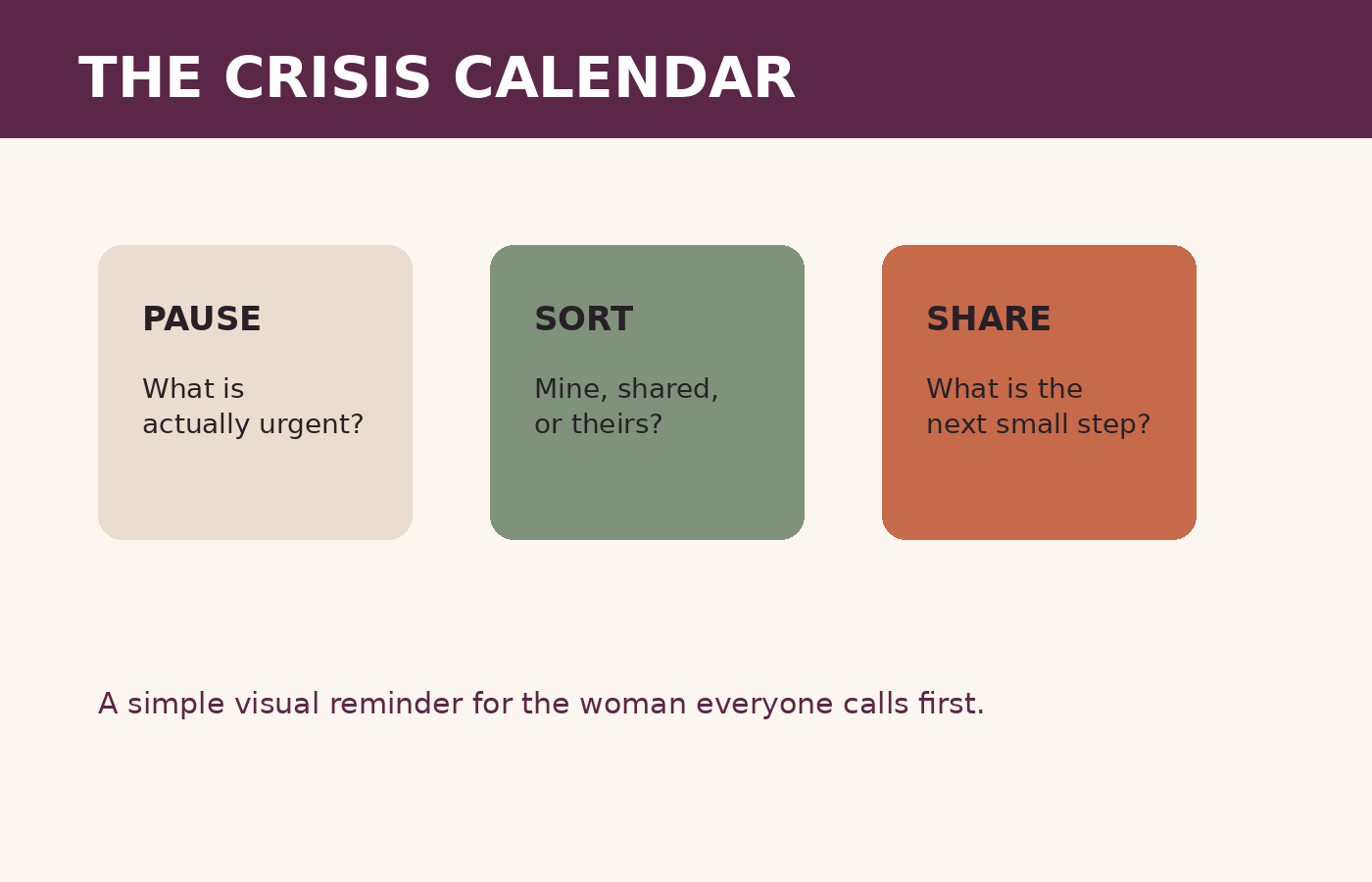
Before replying, create a small gap. Put the phone down. Take one breath. Ask these three questions:
👉 **Is this truly urgent?** Is there immediate danger, a serious health concern, or a deadline that cannot safely move?
👉 **Is this mine to solve?** Am I the responsible person, or merely the most available person?
👉 **What is the smallest useful help?** Could I listen, share information, make one call, or contribute a fixed amount without taking over?
A pause is not cruelty. If you want to understand the wider pattern of automatic yeses, read The Approval Debt Loop. It is how you return choice to the moment.
For genuine emergencies involving immediate danger or serious medical symptoms, contact appropriate local emergency or professional support. A boundary is not a substitute for urgent care.
Sort the request before you accept it
Try putting each request into one of four boxes:
👉 **Mine:** A responsibility I have agreed to and can reasonably handle.
👉 **Shared:** Something that needs several people, not one person pretending she can do it all.
👉 **Theirs:** A decision, task, or consequence that belongs to another capable adult.
👉 **Professional:** A situation that needs a doctor, lawyer, counsellor, financial adviser, school, or emergency service.
This sorting exercise is simple, but it interrupts the old reflex. You are no longer asking, “How can I rescue this?” You are asking, “What is the right container for this problem?”
Replace rescue with specific support
Vague help expands until it consumes the whole day. Specific help has edges.
Instead of, “Send me everything, I’ll handle it,” try:
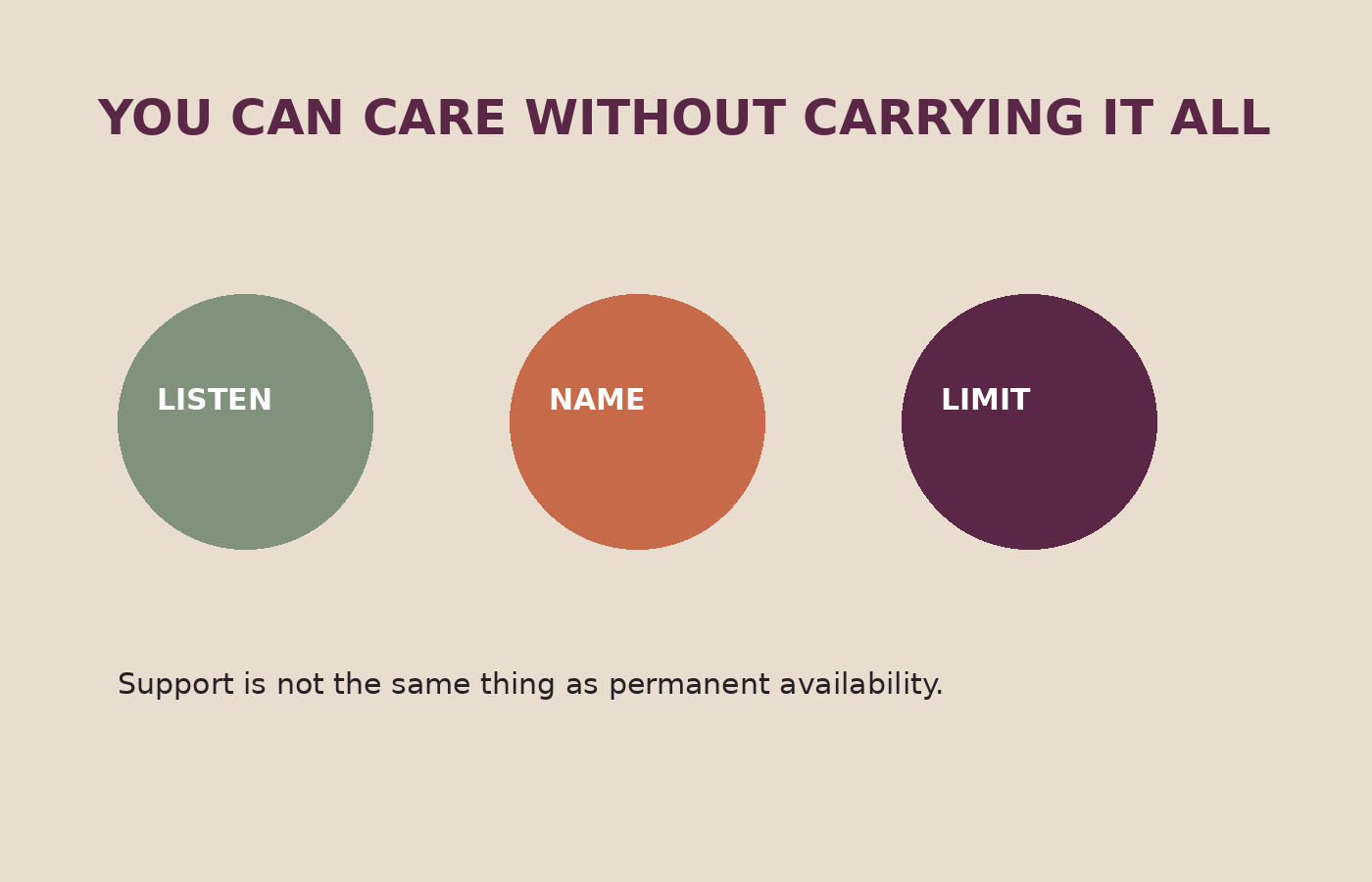
👉 “I can listen for fifteen minutes, but I cannot coordinate the entire situation.”
👉 “I can help you find two options. You will need to make the call.”
👉 “I can contribute this amount once. I cannot make this a monthly arrangement.”
👉 “I am not available tonight. I can check in tomorrow afternoon.”
👉 “This sounds bigger than what I can safely advise on. Please contact a qualified professional.”
These are not cold scripts. They are accurate scripts.
**Quick Tip: Define the help in time, money, action, or availability. If you cannot name the limit, the request may quietly own you.**
Let other people experience their part
This is the part many women avoid, because stepping back can feel like abandoning someone.
But rescuing an adult from every consequence does not always help them become more capable. It may teach the whole system that planning, apologising, paying, remembering, and repairing will eventually be done by you.
You can care about someone and still allow them to make the call. You can believe a problem matters and still refuse to become its project manager.
Misery loves company, but that does not mean you must join every emergency emotionally. Sometimes the kindest thing you can offer is calm clarity: “I understand this is difficult. What do you think your next step is?”
Build a shared crisis plan
If your family or team repeatedly depends on you, do not wait for the next fire to negotiate the system.
Have a calm conversation when nobody is actively panicking. Write down:
👉 Who handles which recurring responsibilities?
👉 Who are the backup people?
👉 What counts as an emergency?
👉 Which professionals or services should be contacted first?
👉 What information should be stored somewhere accessible, rather than inside your memory?
A shared note, calendar, or contact list can become a safe haven for practical information. The goal is not to control everyone. It is to stop one exhausted person from becoming the only place where the whole system lives.
Expect resistance without treating it as proof
When you change your role, people may say you have changed. They may call you selfish, unavailable, dramatic, or difficult.
Sometimes they are describing the loss of their convenience, not a failure in your character.
You do not need to win a courtroom case before setting a limit. You can repeat yourself without adding six paragraphs of evidence:
“I hear that you are disappointed. I am still not able to take this on.”
“I care about you. My answer is no.”
“I have explained what I can offer. I am not available for more than that.”
Calling bullsht on the idea that love must always look like immediate self-abandonment is not selfishness. It is honesty.
A small practice for this week
Choose one recurring crisis that has become your automatic responsibility. Do not begin with the biggest, most dangerous issue. Start with a pattern that is safe to change.
Write four sentences:
1. **The request:** What am I usually asked to do?
2. **The real responsibility:** Who should own the next step?
3. **My bounded offer:** What can I genuinely provide?
4. **My unavailable part:** What will I no longer carry?
Then communicate it before the next crisis, not in the middle of one.
In your heart of hearts, you may still feel guilty. That does not mean the boundary is wrong. It may simply mean your nervous system is used to being rewarded with relief whenever you over-function.
You are allowed to be loving without being on call. You are allowed to help without taking over. And you are allowed to build a life where your goodness is part of you, not the emergency infrastructure for everyone else.
Scope note: This article offers general education and practical reflection, not medical, legal, financial, or mental-health treatment. If someone is in immediate danger or you are experiencing severe distress, contact appropriate local emergency or professional support.