The Hidden Cost of Being the Woman Who Never Says No
Why helping everyone can leave you exhausted, resentful, and strangely guilty – and what to do before your next automatic yes.
From The Unburdened Woman | 7 minute read

The message arrives while you are already tired.
"Please, can you help me with something?"
You have not even heard the favour yet, but your mind is already preparing to say yes.
You think about what might happen if you refuse. Will she be offended? Will he think you have changed? Will the conversation become awkward? Will you have to explain yourself until your no sounds reasonable enough to be accepted?
So when the request finally comes, you agree.
For a few seconds, you feel relieved. Nobody is disappointed. There is no uncomfortable silence. The relationship still feels safe.
Then you look at your calendar, your bank balance, or the work already waiting for you.
The relief fades. Resentment takes its place.
You wonder why people always come to you. You are irritated with the person who asked, even though you know you said yes. Then you feel guilty for being irritated, so you promise yourself you will be kinder next time.
And when the next request comes, you say yes again.
The pattern underneath the favour
That cycle has a name
I call it The Approval Debt Loop™.
You say yes to avoid a few uncomfortable seconds. That yes buys immediate relief, but the relief is borrowed. You repay it later with your time, money, rest, attention, or resentment.
The favour may be small. The emotional bill often is not.
Then guilt keeps the cycle moving. You feel bad for resenting the person, so you become even more determined to be helpful. The next yes begins before you have recovered from the last one.
How kindness quietly becomes obligation
Many women are praised for being dependable long before they learn to ask whether being dependable is costing them too much.
You may have learned that a good woman keeps the peace, helps without being asked, and does not make other people uncomfortable. Perhaps your usefulness became part of how people described you. Reliable. Selfless. Easy to work with. Always there.
Those qualities can be beautiful. But they become expensive when you believe you must be available to deserve love, respect, or belonging.
The problem is not kindness.
The problem begins when fear makes the decision before kindness has a chance to choose.
Sometimes you do want to help. Sometimes you have the time and energy. Sometimes saying yes is exactly right.
But if every request feels like an emergency and every no feels like a moral failure, you are not choosing freely. You are managing the possibility of someone else's disappointment.
Try this before your next answer
Give yourself ten seconds
You do not need to become confrontational. You do not need a perfect speech. You need a small space between the request and your response.
Do not answer immediately. Take one breath or say, "Let me check."
What will this cost in time, energy, money, or attention?
Would you still agree if you were not afraid of the person's reaction?
Give the shortest honest answer the situation needs.
I call this small space The 10-Second Permission Gap™. It is permission to consult yourself before making yourself available.
Your answer may still be yes. The difference is that it will be a yes you chose, not one fear chose for you.
You do not need a long explanation
Over-explaining often feels polite, but it can turn your boundary into the opening round of a negotiation.
When you give ten reasons, someone only needs to solve one of them to keep pushing.
- "Let me check before I commit."
- "I can't take that on."
- "That won't work for me."
- "I understand that you're disappointed, but my answer is still no."
Clear language may feel strange at first. Strange does not automatically mean cruel. Sometimes it simply means you are doing something differently.
The goal is not to control how another person reacts. You cannot guarantee that nobody will be disappointed. The goal is to stop letting the fear of that reaction make every decision for you.
Why I began paying attention
I was living in reaction to other people's moods
My name is The Unburdened Woman
For a long time, I was the dependable one. The peacekeeper. The woman people called when something needed to be handled.
From the outside, it looked like kindness. Inside, I was tired and increasingly resentful.
One morning, while brushing my teeth, I caught myself wondering whether I had offended someone I had not even spoken to that day. It was such a small thought, but it showed me how much of my life had become organised around other people's possible disappointment.
I did not need another speech about choosing myself. I needed something practical for the moment a request was made, before fear answered for me.

What an honest boundary can change
A boundary will not solve every relationship problem. It may reveal some.
A friend may be surprised when you stop agreeing automatically. A colleague may ask why you cannot take on one more task. A relative may still push after your first no.
That discomfort does not mean the boundary was wrong.
It may simply mean the relationship is adjusting to the fact that your time is no longer available without your consent.
You can care about people without being available for everything.
You can be generous without promising what you cannot give. You can disappoint someone and still be a good person. You can feel guilty and decide not to obey the guilt.
The ten-second pause is a small beginning. But small beginnings matter when the old response has been automatic for years.
When you need more than one sentence
Practical words for family, work, friendship, and difficult requests
The ten-second pause helps you stop the automatic yes. The next challenge is knowing what to say, especially when the request comes from someone close to you or someone who does not accept your first answer.
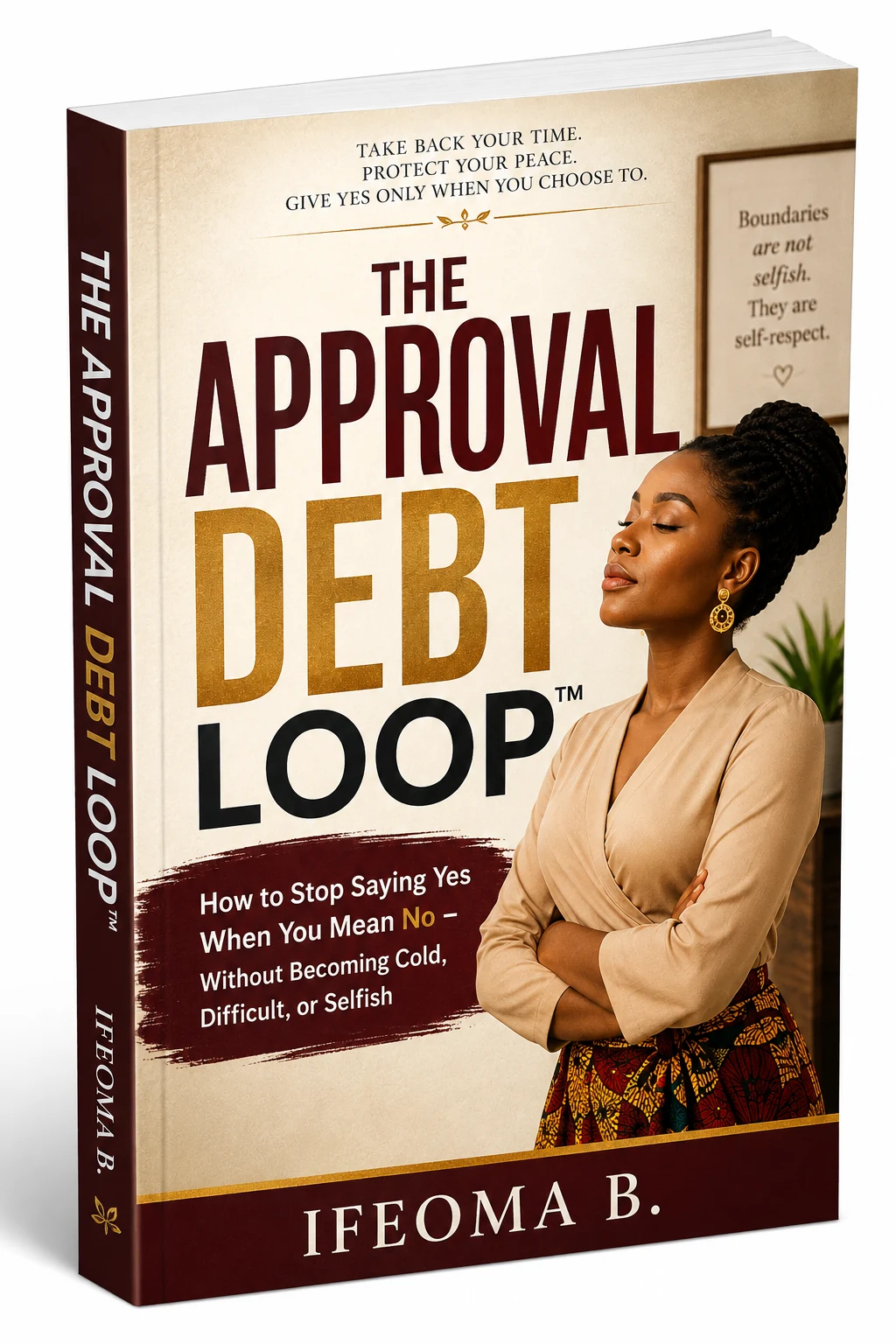
I created The Approval Debt Loop™ as a practical guide for those moments.
It includes the full process, 42 boundary scripts, calm responses for pushback, a quick-reference card, and a 30-day practice plan.
If this pattern feels familiar, you can explore the guide and decide whether it is the right next step for you.
The guide is a self-guided educational resource based on lived experience. It is not therapy and does not diagnose or treat a mental-health condition.